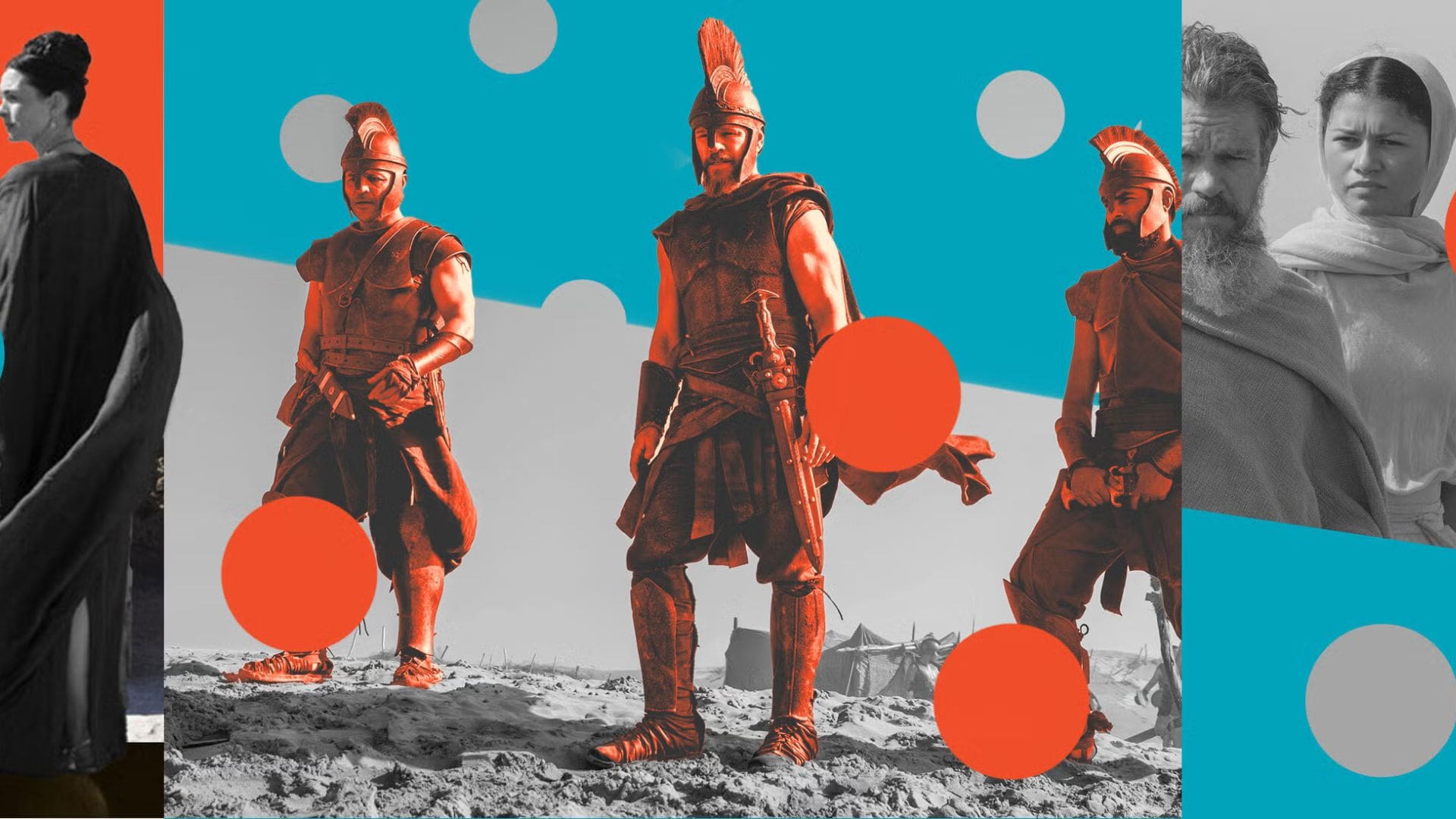
The first thing to know about Homer’s The Odyssey, as classic (and classical) as literature gets, is that it isn’t really text at all. The story, dating back to the 8th century BCE, comes down to us through an ancient oral tradition. It wouldn’t get a written version for a very, very long time, yet its power remains indelible. That, and its elemental tropes—the quest, heroism, monsters, sacrifice—are no doubt what drew Christopher Nolan to make his immense, innovative, IMAX-scaled, Matt Damon-starring blockbuster, in theaters starting on July 17.
But given that The Odyssey has been told and retold, interpreted and reinterpreted, so many times, what do we really know about the underlying mythology? (Yes, in spite of what some questionable folks on social media might tell you, The Odyssey is a myth, otherwise known as fiction, albeit one that historians generally agree is rooted in certain realities of the Bronze Age, including struggles resembling the Trojan War. Homer composed his enduring poem centuries later, and artifacts of the Bronze Age are rare. Also the cyclops, last time we checked, does not exist.)
READ MORE: How Prince Grootboom Moves with Purpose in Netflix’s 180
So no, The Odyssey is not history. But it is historically significant, and Nolan is cunning in the ways he unspools the various twists and turns that have, for about 2,800 years now, captivated the public and held up a mirror to the way various cultures understand themselves. The Oppenheimer auteur was always up against a mountain of classicist thinking, including seminal translations of The Odyssey by E.V. Rieu, Robert Fagles, Emily Wilson, and recently, Daniel Mendelsohn.
But Nolan, based on a recent Time profile, seems more surprised by the current cultural feuding, including over whether it’s “woke” to cast Black and trans actors as part of his stacked ensemble. (Then again, did Achilles actually look like Brad Pitt in Troy? Does anyone look like Brad Pitt except Brad Pitt?) Or the particular boat architecture in the film—more hulking and Viking-like than smaller Mycenaean galleys, the critics say. Or, yes, the shading of a particular king’s armour.
Mendelsohn, for one, is amused by “all of these bros suddenly worrying about Greek literature,” the BBC reported.
That is, in part, because Homer’s The Odyssey has always been “woke”—or put another way, progressive, changing with the times, alive to how we decode its symbols. Here are elements of The Odyssey that have always been malleable (which tends to happen with oral poems lasting thousands of years), how scholars view them, and how Nolan shapes and reshapes their deeply visceral depiction in his film.
(By the way, the movie is a banger.)
About Those Accents

What did ancient Greeks sound like? Was their accent European, or more Staten Island? Does it matter? Because they definitely weren’t speaking English.
Yes, Nolan opts for his actors (many of them British) to use a fairly neutral American-sounding tone. That was probably for consistency more than anything else. And, per Nolan himself, to showcase the intention behind the words (originally written in Homeric Greek, an ancient dialect that virtually no one knows now).
READ MORE: Peaky Blinders: The Immortal Man Is Its Most Brutal Chapter Yet
“Intent on finding ‘language that has emotional not intellectual meaning to people,’ Nolan opted to use colloquial, contemporary dialogue when constructing his script rather than artificially elevated speech,” the Los Angeles Times reported.
“I was maybe being naïve, it might bite me on the ass, but I wanted an earthy narrative. To me it was a no-brainer.”
Understandings of Race and Gender Identity

One of the more hotly debated choices in The Odyssey is casting that includes people of color and, with Elliot Page, a transgender actor—all, mind you, in small roles. Elon Musk was one of the armchair commentators who, having not watched the film, criticized the supposedly “woke” direction.
Is it weird for Lupita Nyong’o, who is Black and of Kenyan descent, to play Helen of Troy (and, in a dual role, her sister Clytemnestra)? According to classics heavyweights, not really: “Mendelsohn said Nyong’o’s casting made more sense than that of Matt Damon, who is part-Scottish, as Odysseus, a character who came from the eastern Mediterranean,” the Telegraph reports.
READ MORE: Why Sinners Is a Must-See and How You Can Watch It Today
“Who knew that Elon Musk knew so much about the Greek legends?” Mendelsohn said at the Hay Festival. “One of the great things about Elon Musk dipping his toes in classical philology is that it has generated the funniest memes of all time. Somebody was like: ‘Who knew Helen of Troy would still be causing men to melt down?’”

Page (a Nolan regular since Inception) plays a similarly minor, though significant, role—as a man. I’ll just say that Robert Pattinson’s villainous Antinous is terrified at the mention of the character’s name. While the actor’s transgender identity does not figure into the plot, it wouldn’t be wild if it did: “Although the term ‘transgender’ is a modern construct, the ancient Greeks and Romans were aware of the idea that a person of one sex could somehow transform themselves into another sex,” a University of North Carolina Asheville study writes.
Travis Scott, the Black rapper, also has a role as a bard in the banquet halls in Ithaca, where Queen Penelope (Anne Hathaway) awaits the return of her husband Odysseus. He helps narrate the story—just as the original Odyssey would have been told.
“I cast him because I wanted to nod towards the idea that this story has been handed down as oral poetry, which is analogous to rap,” Nolan told Time.
While issues of racial identity have overwhelmed discourse around Nolan’s Odyssey, the simple truth is that ancient Greeks would be puzzled by this framing.
“The terms ‘black’ and ‘white’ did not hold the same meaning to the Greeks as they do to us,” a University of Leeds study notes. “Whiteness and Blackness became tied to race during the Enlightenment, irreversibly changing the meaning of these terms.”
Agamemnon’s Armour

Agamemnon, king of the victorious Greek forces in the Trojan War, is played somewhat improbably by… indie director and actor Benny Safdie (recently the director of The Smashing Machine and seen as the villain in Happy Gilmore 2 ). But what’s unmissable about his presence is the sleek black armor, embellished with an exoskeleton-like gold trail on the back of his helmet.
This set people off. Does it look like a Batsuit? Kind of. But Agamemnon is all about intimidation. And while we can’t say this is what most soldiers in the Bronze Age would have worn, he was no mere soldier. And anyway, it seems plausible enough.
“There are Mycenaean daggers that are blackened bronze. The theory is they probably could have blackened bronze in those days. You take bronze, you add more gold and silver to it and then use sulfur,” Nolan told Time. “Ellen [Mirojnick], our costume designer, is trying to communicate how elevated he is relative to everyone else. You do that through materials that would be very expensive.”
Also, it looks cool.
Gods Get Grounded

The Odyssey, being one of the most important relics of Greek mythology, is all about the intervention of Gods (they had many). Damon’s Odysseus has to contend with the beautiful Charlize Theron as the nymph Calypso, holding him captive for years on her island (though it looks like paradise). He also faces the infamous cyclops (a stunning visual feat), Samantha Morton’s enchantress Circe (the most mind-boggling sequence in the movie), and the vengeful sea god Poseidon. There are also a number of moments along the journey with Athena, played by Zendaya, the goddess of wisdom, warfare, and handicraft.
Poseidon, along with some other gods who loom large over the tale, are not exactly personified as walking, speaking human beings. If actual classics experts have something to quibble with, it would be this.
“There is all this magic and all this divine action going on,” says Carolina López-Ruiz, a professor at the University of Chicago’s Divinity School.
READ MORE: How to Watch One Battle After Another Plus Why Everyone Is Talking About It
“Now, when you put these stories on screen, you have two choices: Either you make them more theologically modern, where the gods are aloof, even abstract entities that represent, you know, the weather, whatever abstract notions. Characters only interact with them by praying or cursing or some ritual, or you can go fully Homeric and show them as in the poems, sometimes visible, quarreling among themselves and changing the plot in very specific ways.”
Now, Theron is a flesh-and-blood entity to be sure. But we’ll say that Nolan’s Odyssey does not quite go full Homeric in other divine representations. It’s still unclear what the anti-”woke” critics have to say about that.
This article by Paul Schrodt was originally published on Men’s Health US