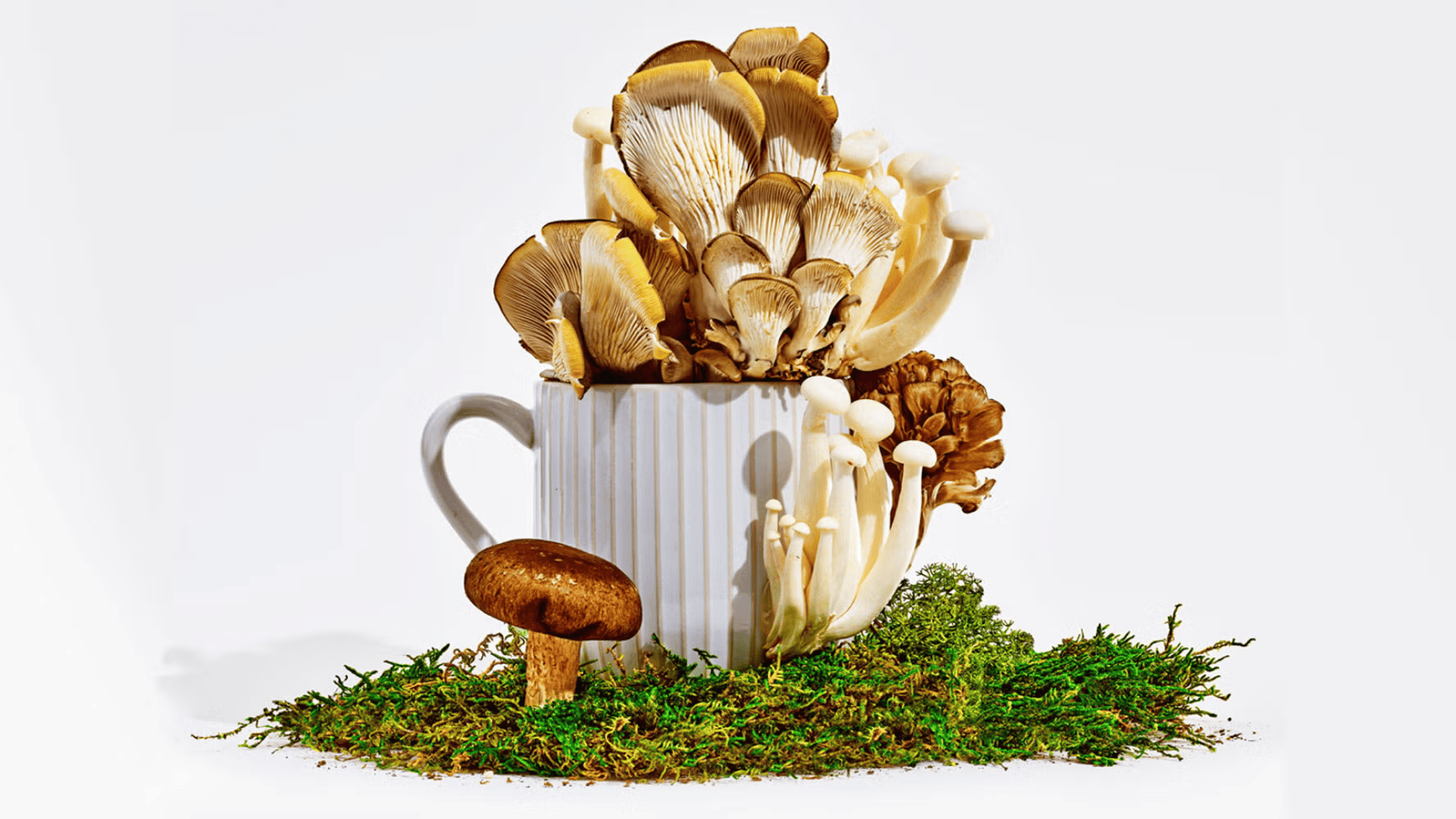
Once relegated to the dusty bottom shelf of health food stores, functional mushrooms are now found in teas, coffees, supplements, and even protein bars and chocolate.
But along with that newfound visibility have come some impressive-sounding claims. Functional mushrooms are marketed for everything from sharper thinking to better workouts to improved gut health, stress reduction, and sleep. But can mushrooms do all of that? Let’s take a look.
What Are Functional Mushrooms?
Complicated question. First know that mushrooms can be categorized as functional, culinary, psychoactive, and toxic—although there is some overlap between categories. Shiitake mushrooms, for example, are considered culinary and functional.
Functional mushrooms are fungi that are thought to have specific physiological benefits, mostly involving cognition, sport performance, digestive health, and mood. Unlike psychedelic mushrooms, functional mushrooms do not contain psilocybin and will not get you high. (Sorry.)
According to Grand View Research, South Africa’s functional mushroom market includes varieties such as lion’s mane, reishi, chaga, cordyceps, turkey tail and shiitake, with shiitake accounting for the largest share of the local market in 2023.
Are Functional Mushrooms Healthy?
The claims are way ahead of the evidence.
Research is still focused on discovering whether many of these fungi produce clinically meaningful outcomes in humans. Despite the confident claims companies make about their mushroom products, supporting evidence remains elusive. A search for citations or evidence on most functional mushroom product websites comes up empty.
In South Africa, products marketed as health supplements fall under the South African Health Products Regulatory Authority’s (SAHPRA) framework for Category D complementary medicines. But that doesn’t necessarily mean every supplement you find on the shelf has been individually evaluated by SAHPRA. In fact, unregistered complementary medicines are required to carry a disclaimer stating that they have not been evaluated by SAHPRA for their quality, safety or intended use.
READ MORE: 3 Ways Mushrooms Can Improve Your Performance At The Gym
There are also limits on what these products can claim to do. SAHPRA permits health supplements to make low-risk claims around things such as general health enhancement, maintaining health or relieving minor symptoms, rather than claiming to treat or prevent specific diseases. That still leaves plenty of room for brands to promote benefits linked to things like stress, cognition, energy and general wellbeing.
You don’t have to look far to see those claims in action. A 250g bag of South African brand Mindful Roast’s Mushroom Coffee sells for R200 and combines reishi and lion’s mane. The brand markets the blend around “balanced energy” and “clearer focus”, while describing the mushrooms as supporting focus, calm and overall wellbeing.
South African wellness brand Motherkind Co says its Shroom Elixir, a blend of four mushroom extracts, can assist with “boosting immunity”, enhancing natural energy and improving memory and focus.
Locally, similar promises are easy to find. Remedy Greens markets its Nootropic Mind Health blend around “focus, clarity and calm”, combining lion’s mane with ashwagandha, rhodiola and South African botanical sceletium. A tub sells for R399 and provides a 6g serving, although the product page does not specify how much of each individual active ingredient that serving contains.
Not every brand takes the same approach to ingredient transparency. Motherkind, for example, lists the individual quantities of each mushroom extract in its Shroom Elixir. But some supplements use proprietary blends, where the total amount of a blend may be disclosed without specifying exactly how much of each active ingredient it contains.
While companies may use proprietary blends to protect their formulations, the practice can make it difficult for consumers to determine how much of a particular ingredient they’re actually getting, or whether that amount is comparable with doses used in scientific research.
That matters because, for many functional mushrooms, researchers have yet to establish a clear, universally accepted effective dose.
There are also questions around the claims used to market these products. In South Africa, objective advertising claims are expected to be supported by appropriate evidence under the Advertising Regulatory Board’s Code of Advertising Practice.
And scrutiny of mushroom supplements isn’t limited to South Africa. In the US, the National Advertising Division opened an inquiry into claims made by mushroom coffee company Ryze around energy, focus, digestion, immune support and sleep, as well as an implied comparison between one of its products and GLP-1 medications. Ryze voluntarily discontinued the challenged claims before the NAD assessed them on their merits.
So what evidence are mushroom companies using to support their claims in the first place?
Where the Science on Functional Mushrooms Stands Now
Functional mushrooms contain biologically active components, and some of them have exhibited some positive health-related effects in lab and animal research. But lab and animal studies don’t necessarily translate into meaningful benefits in humans.
Human trials using functional mushrooms have been mostly small, and their results have been mixed. We need bigger and larger human trials to understand which functional mushrooms may actually be useful, and in what dose and form.
Julie Daoust, PhD, Chair of the Functional Mushroom Council, argues that it’s important not to dismiss mushrooms altogether even though the evidence base is far smaller than that of a pharmaceutical drug.
“The population-level evidence for mushrooms as food is genuinely strong and shouldn’t be dismissed just because it’s not a randomised trial,” she says. “The clinical research on specific mushroom products, while younger, is accumulating fast and already includes are genuinely impressive results.”
She points to PSK, an antioxidant from the turkey tail mushroom, which is an approved adjuvant cancer drug in Japan. Its sister compound, PSP, has shown similar immune-supportive effects in cancer patients undergoing conventional treatment.
This is different than marketing a mushroom gummy for its supposed functional benefits; the turkey tail used in Japan is a purified compound that’s not even close to a consumer product.
Mushrooms contain beta-glucan, a fermentable fiber with proven effects on the gut microbiome, and potential benefits for immune system markers such as natural killer and T-cell numbers. Once again, we aren’t sure that these immune effects translate into clinically meaningful outcomes in humans.
Lion’s mane mushrooms are one of the more popular functional mushrooms right now, particularly for cognition and mood. Small studies have suggested a link between lion’s mane mushroom and a decrease in stress and improved cognitive function, although research findings on those effects are mixed. None of this is proof that lion’s mane will transform your brain, energy levels, or mood.
Daoust points out that the dramatic increase in mushroom research trials represents meaningful progress for a category that was barely being clinically tested a decade ago. Still, it’s not yet the hundreds of trials that we see behind established pharmaceuticals.
Are Functional Mushrooms Safe?
Be careful. All mushroom species are “bioaccumulators,” meaning they absorb and concentrate compounds from the soil they grow in, both beneficial and harmful. Studies have detected contaminants like arsenic and other potentially toxic metals in mushroom samples, although the levels found in commercial supplements have not been high enough to pose a health risk.
Certain mushrooms have their own concerns. Chaga, for example, contains high levels of oxalate. Heavy, prolonged use has been linked to kidney injury, making chaga a potential risk for people who have kidney disease or a history of kidney stones.
READ MORE: NEW STUDY: The Mood-Boosting Magic of Mushrooms
As with all other supplements, products containing functional mushrooms should be third-party-certified to ensure quality and purity.
Daoust recommends looking for products that clearly identify the mushroom species by its Latin name, the part of the fungus used, the solvent and solvent ratio if it’s an extract, and the growing substrate. Proper labeling is the key to understanding the consistency of a product’s sourcing and to actually getting the expected effects.
This information doesn’t prove that a product works; it gives consumers a good idea of what exactly they’re purchasing.
Because mushrooms can pull toxins and pollutants from their growing environment, sourcing and independent testing are important.
What About Mushroom-Enhanced Foods?
They might seem like a more attractive option than swallowing powder or capsules, but dose matters. If the effective dose of a given mushroom is 3 grams, and your chocolate or gummy only contains a few dozen milligrams, you’re likely consuming more marketing than mushroom.
Unfortunately, because many functional mushrooms don’t yet have an established dose, figuring out whether a product contains enough can be a challenge.
Functional mushrooms aren’t woo woo nonsense; many of them contain biologically active substances that seem to have products some promising outcomes in the research. But as usual, the consumer market has gone far beyond the current evidence.
If you enjoy mushroom coffee or want to experiment with a reputable mushroom supplement, go for it. But, I wouldn’t expect dramatic results as of now.
This article by Abby Langer, RD originally published on Men’s Health US