
We hate to break it to you, but there’s no such thing as the perfect programme. At least, not on paper.
As close to perfect as you’re going to get is the programme you can stick to consistently over weeks, months and even years. One with a built-in mechanism for progressive overload that enables you to keep lifting heavier dumbbells, adding more weight to the bar and performing more reps over a long enough timeline.
If you’re tight on time, it becomes even more important that you’re following that golden rule of progressive overload. If you’ve got six days a week to spend in the gym for two hours at a time, you can almost accidentally make gains. But if you’re limited to three days per week, without all the time in the world for those sessions, you need to be a little more exacting with the time you do have.
That’s where the 3 x 3 x 3 method comes in. Its simplicity is its greatest strength. Which will hopefully lead to your greatest strength. (And by that, we mean PBs in the bench press.)
RELATED: The Most Effective Bench Press Workout of All Time
What Is the 3 x 3 x 3 Method?
You’re going to train three days per week, perform three lifts in each session and complete three working sets of each lift. It’s simple, effective and efficient. So what’s the catch? You’re going to have to hit those three working sets hard. Very hard. Then rest for three minutes and hit the next set hard again, and again…
This is a choose-your-own-adventure programme where you’ll pick movements that work for you, your goals, the kit you have available and the exercises you actually enjoy. But for the sake of some scaffolding, each session should include a pushing movement, a pulling movement and some sort of lower-body movement. That way, you’re training your full body, more or less, each time you step into the gym, and accumulating volume across every major muscle group throughout the week.
Alternate the order of your movements to ensure you’re not always fatigued when hitting the same body part. In other words, don’t leave legs until last every session.
Spread your sessions across three non-consecutive days, such as Monday, Wednesday and Friday. But don’t get hung up on sticking to a rigid pattern – this method should work with your lifestyle and commitments, not against them.

Choose Your Lifts and Warm Up
Once you’ve picked your three movements, warm up thoroughly and perform a few work-up sets for your first lift, gradually building towards your working weight. Do the same before each subsequent movement. These sets don’t count towards your three working sets. If you’re particularly strong, you may need a few more warm-up sets to get there. Take the time you need without turning the warm-up into a workout in its own right.
RELATED: How Much Weight You Should Be Lifting for Your Age – From Your 20s to 70+
Depending on your goals and the weights available to you, you may work in different rep ranges. But if you’ve got access to a fully kitted-out gym and want to build strength and size, 6-10 reps for each set is a useful starting point for this programme. Choose a weight you can lift for around 6 to 10 controlled reps on your first working set, finishing close to failure. You’ll stick with that weight for all three sets. Your reps may drop as fatigue builds. That’s fine: we’re interested in the total.
Perform 3 Hard Sets
Once you’re warmed up and have selected your weight, here’s how each lift works.
- Perform as many controlled reps as you can.
- Rest for three minutes, then repeat with the same weight.
- Rest for another three minutes, then perform your final working set.
Tot up the number of reps you hit across all three sets and write it down alongside the weight you used. Do this for all three movements, completing all the sets of one exercise before moving on to the next.
The three-minute rest gives you time to recover and helps you maintain your performance from set to set. So use it all. Don’t be tempted to cut it short just to feel like you’re ‘working’. Put that energy into your sets.
How to Progress
Next time you perform a movement, your aim is to complete more total reps across those three sets, using the same weight and the same standard of technique.
Once you can perform at least 20% more than your original total rep count, add weight in the following session. Round the target up to the next whole rep where necessary.
For example, if your first outing with a pair of 30kg dumbbells looks like 10 reps, eight reps and seven reps, your starting total is 25. Your target is now 30 reps across the three sets. That might look like 12, 10 and eight. It doesn’t need to be 10, 10 and 10.
Keep that original target fixed while you work towards it. Once you hit 30, move up to the next manageable weight and establish a new starting total. Then repeat the process.
In this fashion, you’re either aiming to perform more reps or adding more weight and resetting your rep count. That gives you a built-in mechanism for progressive overload, rather than simply turning up and repeating the same workout indefinitely.
The 20% figure is a practical progression rule for this method, not a magic threshold. And you won’t necessarily beat your score every session. The aim is an upward trend over time.
A Note on Intensity
You get three working sets per movement, so we really want to capitalise on them.
You don’t need to train to complete muscular failure – the point at which you can’t perform another full rep with good form – but you do need to get close. Around one or two reps left in the tank is a useful target. If you finish every set knowing you could have performed another four or five, there’s probably room to work harder.
RELATED: 10 Ways You Can Use 5kg Dumbbells to Transform Your Physique
Taking a set to failure is an option, particularly on your final set of an exercise. It ensures you leave no stone unturned, and across such few sets, the fatigue should be more than manageable.
Choose your movements accordingly. A machine chest press or chest-supported row can make it easier to approach your limit without getting pinned beneath a barbell.
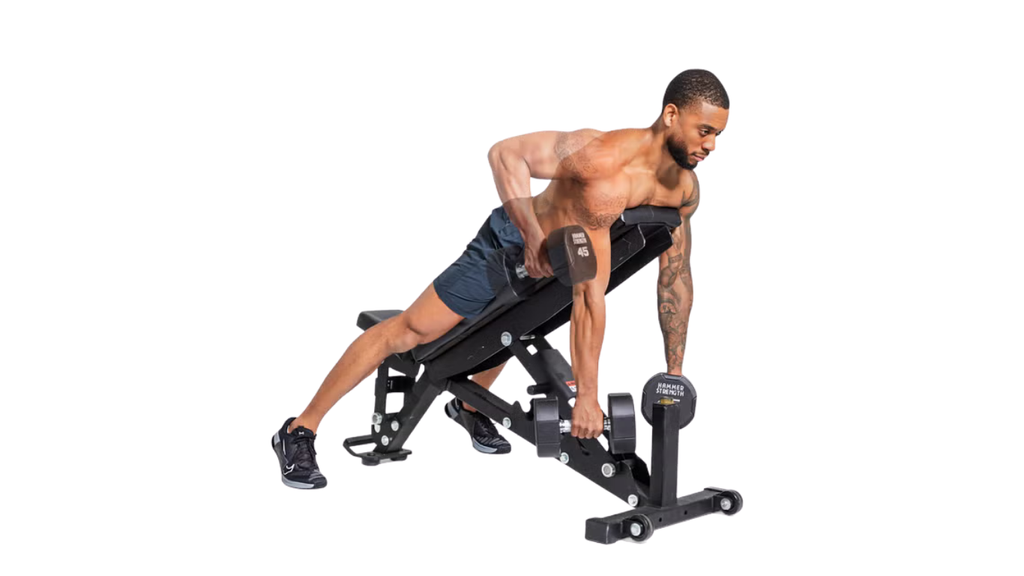
An Example Week of the 3 x 3 x 3 Method
Monday
- Dumbbell Bench Press: 3 x 6-10
- Chest-Supported Dumbbell Row: 3 x 6-10
- Barbell Front Squat: 3 x 6-10
Wednesday
- Romanian Deadlift: 3 x 6-10
- Chin-Up: 3 x 6-10
- Dumbbell Overhead Press: 3 x 6-10
Friday
- Parallel-Bar Dip: 3 x 6-10
- Rear-Foot-Elevated Split Squat: 3 x 6-10
- Chest-Supported Dumbbell Row: 3 x 6-10
Add weight to chin-ups and dips as needed. For split squats, perform both legs to complete one set, then take your three-minute rest. Track the reps for each leg separately, starting with your weaker side and matching it on the other.
Keep these movements consistent from week to week so you have something meaningful to beat. Compare like with like: the same load, range of motion and standard of technique.
Use a single set-up like the one above for 4-6 weeks before swapping movements in order to see solid progress in the logbook.
This article by Andrew Tracey was originally published on Men’s Health UK