
There are plenty of ways to make push-ups harder. Adding weight, elevating your feet, slowing down the reps or sticking a band around your back are all good options if the only thing you’re looking for is more resistance.
Hindu push-ups offer something slightly different.
Rather than simply making a regular push-up more difficult, they force you to move your entire body through a much bigger range, taking your shoulders from an overhead position into a deep press before extending through the spine and reversing the whole thing. Your chest, shoulders and triceps are still doing plenty of work, but you’re also getting movement through your shoulders, upper back, hips and hamstrings.
It’s part strength exercise, part mobility drill, and a pretty useful option if you want to get more out of your warm-ups, bodyweight workouts or simply break up all of that very straight-line pressing.
What Is a Hindu Push-Up?
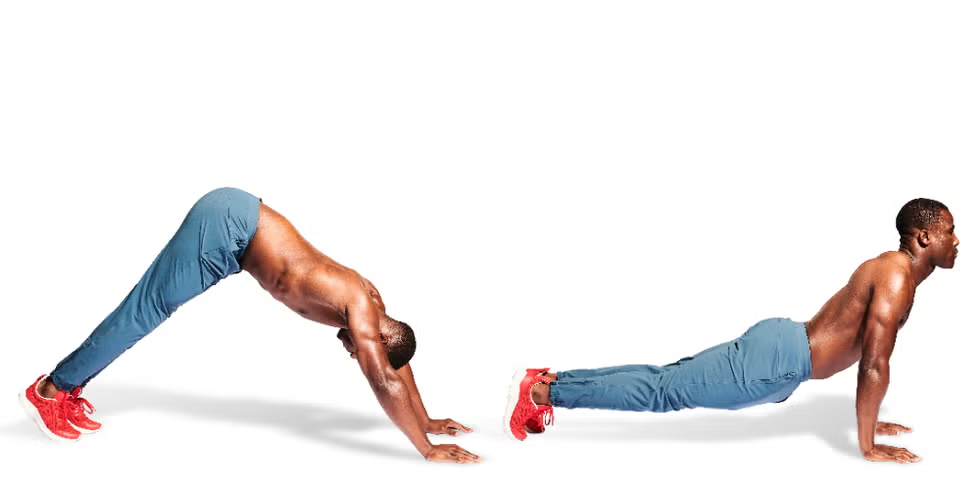
The Hindu push-up is a flowing push-up variation that traces its roots to traditional Indian wrestling, where a similar movement known as a ‘dand’ has been used for centuries by wrestlers to build upper-body strength, mobility and conditioning. The move begins with your hips high and your body forming an inverted ‘V’, similar to a downward dog.
READ MORE: Paradise Star Sterling K Brown, 49, Proves You Don’t Need Heavy Lifting to Build Muscle
From there, you bend your elbows and bring your head and chest forwards and down, almost as though you’re trying to duck underneath a low bar. Continue pressing forwards and then upwards until your arms are straight, your chest is up and your hips are close to the floor.
Unlike the similar-looking dive bomber push-up, you don’t necessarily reverse that exact swooping motion to return. Push your hips backwards and upwards to reset into your starting position.
How to Do Hindu Push-Ups
- Start on all fours before pushing your hips high into an inverted ‘V’. Keep your hands slightly wider than shoulder-width and your arms straight.
- Bend your elbows and lower your head towards the floor, then sweep your chest forwards between your hands, keeping it as close to the ground as you comfortably can.
- Continue forwards, pressing through your palms until your elbows are straight and your chest is proud. Your hips should now be low, but don’t simply dump your bodyweight into your lower back.
- Push through your hands, drive your hips backwards and upwards and return to the starting position. Keep the reps smooth and continuous rather than treating each position as a separate exercise.
If you’re using them as part of a warm-up, 2–3 sets of 10–15 controlled reps is plenty. For more of a muscle-building stimulus, take your sets closer to failure while keeping the movement smooth, rest as necessary between sets and perform 4-5 sets in each workout.
The Benefits
1. Build Your Chest, Shoulders and Triceps
Don’t let all of the flowing fool you: there’s still a lot of pressing going on.
Your shoulders and triceps work hard as you transition forwards, while your pecs contribute heavily as you push through the bottom. The changing position also means those muscles are working through angles you won’t encounter in a standard push-up.
2. More Shoulder Movement
This is probably the biggest reason to add Hindu push-ups into your workouts alongside regular push-ups. At the beginning of each rep, your arms are overhead relative to your torso. You then move through that position and into a press before finishing with your chest up and shoulders extended.
READ MORE: How This Reader Lost 36kg Without Extreme Diets—And Built Serious Muscle
You’re not just stretching the shoulders, you’re actively controlling them through that range. If maintaining mobility is the goal, that’s an important distinction.
3. Mobilise Your Upper Back and Hips
The benefits aren’t confined to your shoulders. Moving between the two positions asks your thoracic spine to move between flexion and extension, while the starting position can provide a stretch through the calves and hamstrings.
Your hips are moving through a considerable range too, making this a particularly good option if you spend half the day folded into a chair.
4. Build Strength Through Bigger Ranges
Strength and mobility don’t need to live in separate parts of your training regime.
Hindu push-ups allow you to load some of these larger ranges with your own bodyweight, helping you build strength and control in positions that might otherwise only appear during your stretching.
5. They Work Well in a Warm-Up
You don’t have to take every set to failure to get something from them. A handful of smooth reps gets your shoulders moving, opens up your upper back and hips and raises your heart rate slightly, making them a good primer before upper-body sessions or full-body training.
This article by Andrew Tracey originally published on Men’s Health UK