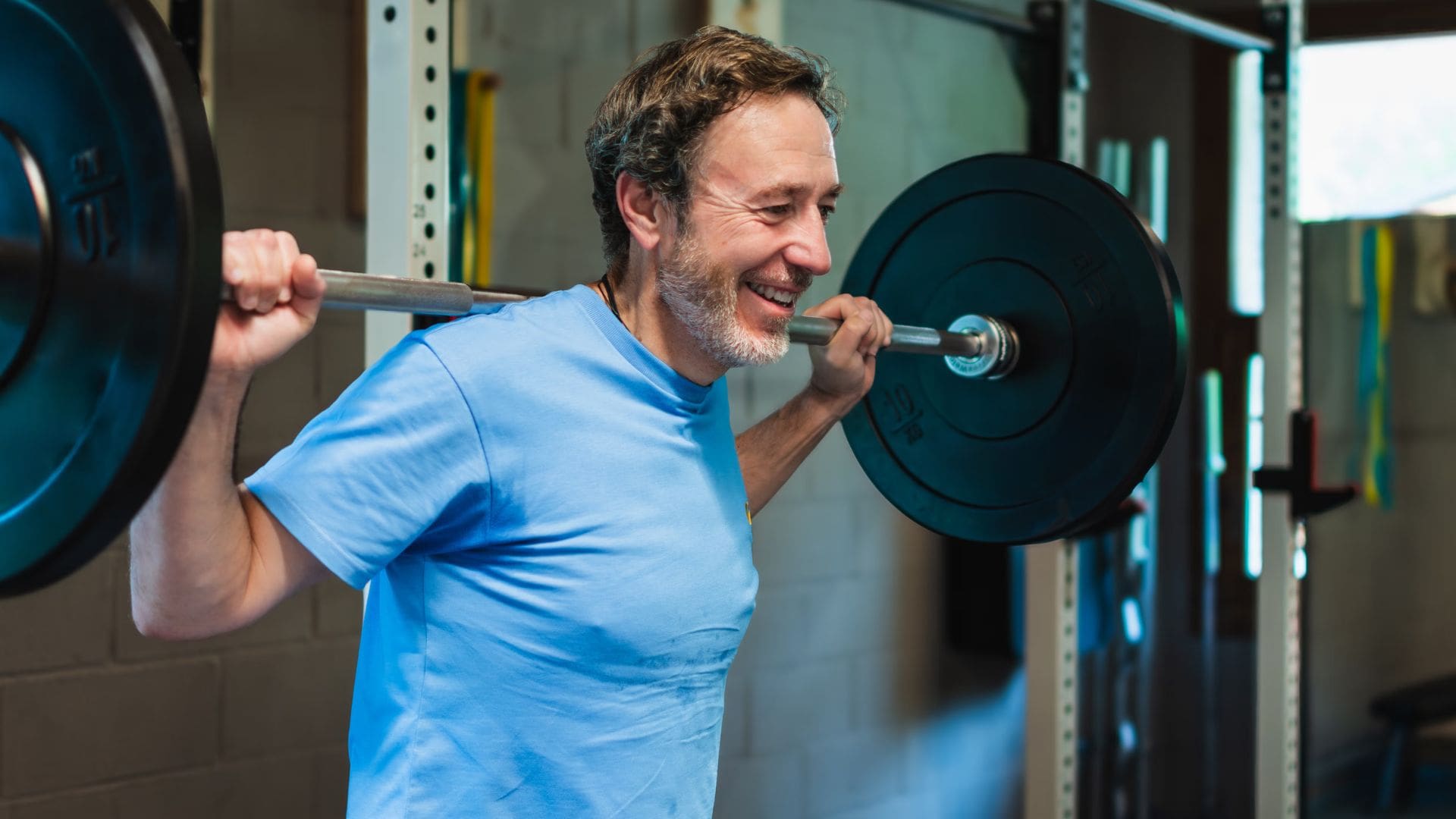
The back squat is one of the clearest ways to assess lower-body strength, but it also demands a high level of control and consistency to perform well. Unlike simpler movements, it challenges your ability to stay stable and coordinated under load.
In your 50s, that becomes even more important. While strength doesn’t automatically decline with age, progress tends to rely more on managing fatigue, recovery and joint health. With the right approach, many lifters can continue building strong squat numbers well into this decade.
Back Squat Strength Standards for Men in Their 50s
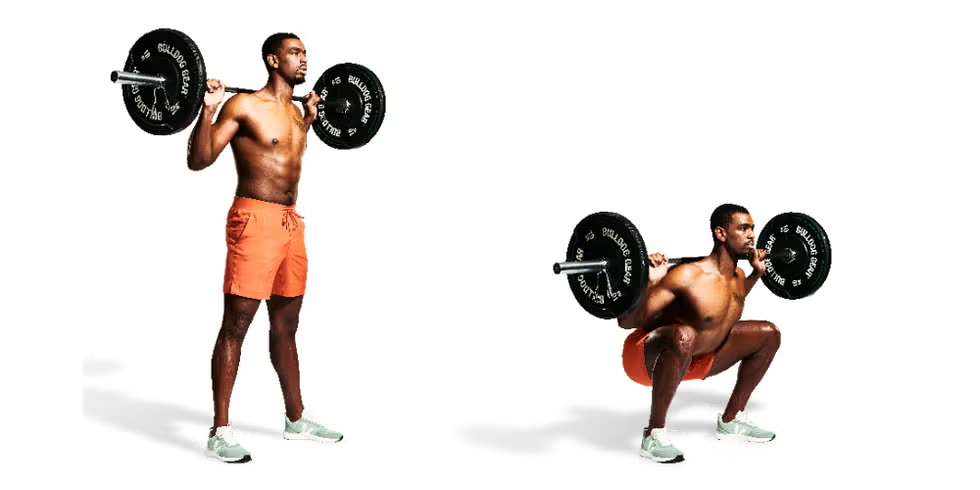
As a general guide, these are realistic benchmarks for a barbell back squat performed to at least parallel for a one-rep max. These benchmarks are derived from the original benchmarks recommended by coach Alain Gonzalez, in a YouTube video where he outlines a series of simple tests that assess strength.
One-Rep Max (1RM)
- Beginner: 0.75-1 x bodyweight
- Early Intermediate: 1-1.25 x bodyweight
- Intermediate: 1.25-1.5 x bodyweight
- Advanced: 1.5-1.9 x bodyweight
- Elite: 1.9 x bodyweight and above
A 1.4-1.5x bodyweight squat represents strong, well-trained lower-body strength for men in their 50s. A double bodyweight squat remains rare outside of dedicated strength training.
5-Rep Max (5RM)
Testing a true one-rep max isn’t always necessary – particularly for beginners or those managing previous injuries. If you’d prefer not to test your maximum lift, the following 5-rep benchmarks offer a useful alternative.
READ MORE: Stop Guessing Your Squat Depth – Here’s What Works for Muscle, Strength and Power
For most lifters, a 5RM typically sits around 85-87% of a true 1RM.
These benchmarks are based on the higher targets outlined above, adjusted to provide a more practical guide for most lifters.
- Beginner: 0.65-0.8 x bodyweight
- Early Intermediate: 0.8-1 x bodyweight
- Intermediate: 1-1.25 x bodyweight
- Advanced: 1.25-1.5 x bodyweight
- Elite: 1.5 x bodyweight and above
If you prefer using dumbbells, expect to handle slightly less total load than with a barbell. Holding dumbbells in the goblet position, at your sides or in a front rack increases the demand on stability, which typically limits how heavy you can go.
Use the numbers above as a rough guide rather than fixed targets. Many factors influence your ability to reach them, including genetics, limb length, training experience, mobility, injury history, training frequency, recovery and individual response to training.
By your 50s, recovery may take slightly longer than it did in your 40s. For that reason, it’s important to adjust training volume to match your recovery capacity. Sleep, stress levels and total weekly training load all play a role in how well your body adapts.
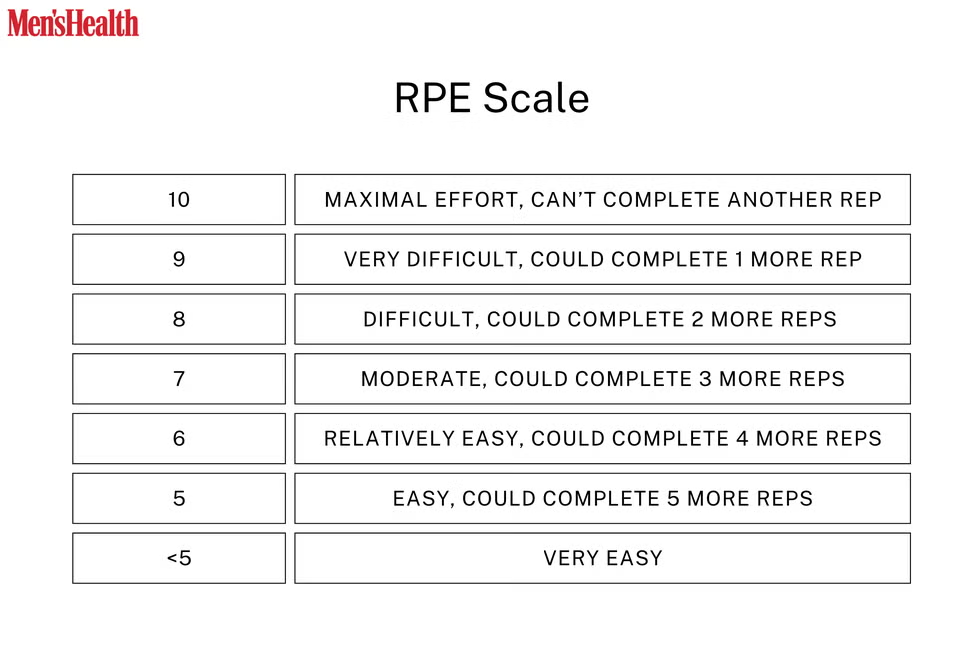
Autoregulation can be particularly useful here. Using tools such as rate of perceived exertion (RPE) or reps in reserve (RIR) allows you to adjust intensity based on how you feel on a given day, rather than forcing progression when fatigue is high.
How to Squat Heavier in Your 50s
Despite what many people assume, it’s still possible to build squat strength in your 50s. The difference is that progress tends to come from training smarter, rather than simply training harder. Focus on the following principles:
Progressive Overload
Gradually increase the load, reps or total training volume over time to provide the stimulus your body needs to adapt. Progress doesn’t have to be weekly – small, consistent increases are more sustainable.
Training Close to Failure
You don’t need to push every set to absolute failure. Working a few reps shy of failure is typically enough to stimulate strength gains while still allowing for recovery.
READ MORE: Are You Squatting Enough? Here’s How to Measure Your Strength
Managing Fatigue
Recovery becomes increasingly important in your 50s. Sensible programming, occasional lighter weeks and adequate rest between heavy sessions will help maintain consistent progress.
Accessory and Prehab Work
Strengthening the muscles that support your squat can improve performance and reduce injury risk. Exercises such as split squats, step-ups, hamstring work and core training can reinforce stability and control under the bar. Adjusting stance, depth and squat variation to suit your structure can also improve comfort and longevity.
Consistency
Above all, consistency remains the most important factor. Pair structured training with sufficient recovery, adequate protein and calories, and good sleep, and you can continue building strength into your 50s and beyond.
This article by Kate Neudecker was originally published on Men’s Health UK